
Hugo Tieleman
Echoes of The Green
24.10 - 21.11
Link to the artworks: Hugo Tieleman
For this series of works, I went back to the source. Literally, but also conceptually. I spent a lot of time in the woods. To observe how life moves, how it fades away and how it begins anew. Rotting wood, mushrooms and fungi stand alongside newly sprouting plants. What appears to be dead becomes fertile soil. What we call weeds keep coming back. In nature, nothing exists in isolation. Everything is part of a greater whole. Everything is broken down, absorbed and reused.
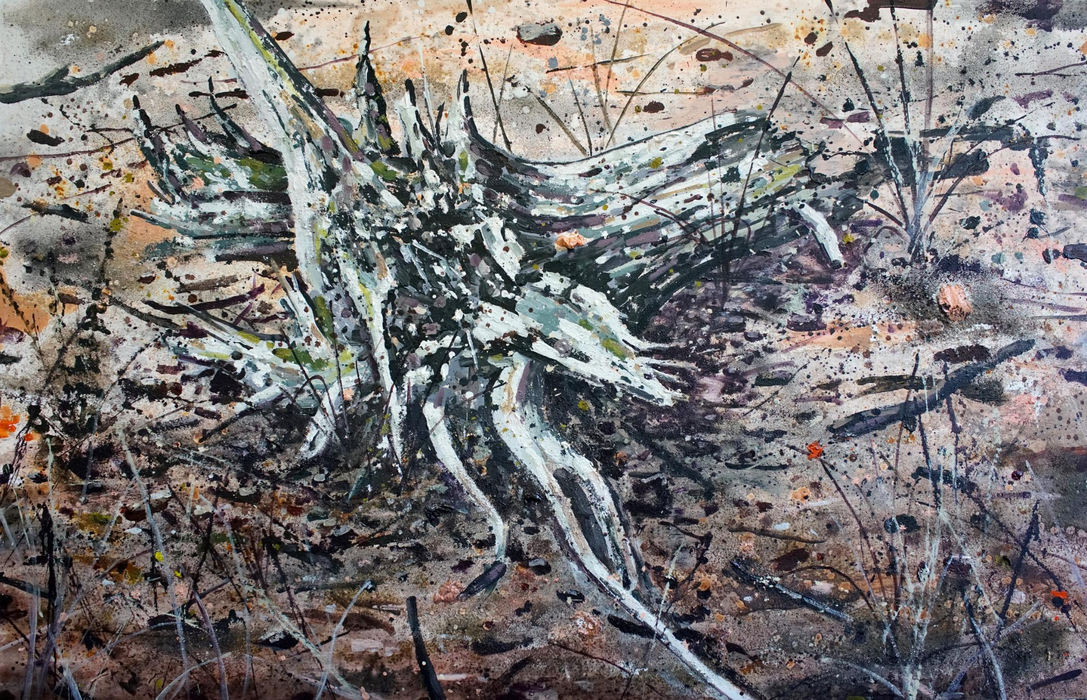
Mycelium 2, 110 x 170 cm, 2026
It is precisely in this that I see a parallel with the world in which we live. We have distanced ourselves further and further from that source. We fell forests, deplete the soil, pollute the water and the air, and destroy habitats. We act as if nature were a larder from which we can take without limit, and as if what we leave behind were no longer part of the system.
But when nature disappears, it is not just trees, plants and animals that vanish. The connections that make life possible also disappear. Soils lose their fertility. Water becomes polluted. Species go extinct. Ecosystems become unbalanced. And as these systems are further damaged, we too become more vulnerable: to drought, flooding, food shortages and a living environment that leaves less and less room for life. What we destroy, we cannot simply replace. A forest is more than just timber. Soil is more than just earth. A river is more than just water. They are living systems that have developed over a long period of time and on which we depend.
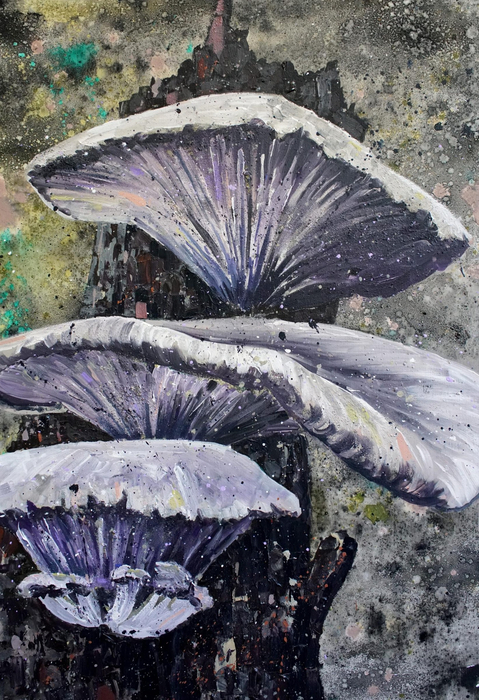
Mycelium 4, 150 x 100 cm, 2026
The mycelium – the network of fungal threads beneath the ground – reveals what we often choose not to see: everything is interconnected. Trees, plants, soil and fungi are not separate worlds, but parts of a single living system. The same applies to our world. The air we pollute, the water we contaminate and the soil we deplete do not remain at a distance. Everything has a knock-on effect. What we do here has consequences elsewhere. What we leave behind now becomes part of the world we pass on. And if we do nothing, it is not just nature that will continue to disappear. We will be passing on a world in which less life is possible, in which natural systems find it increasingly difficult to recover, and in which the consequences of our choices are felt ever more directly. Not only for future generations, but also for ourselves.
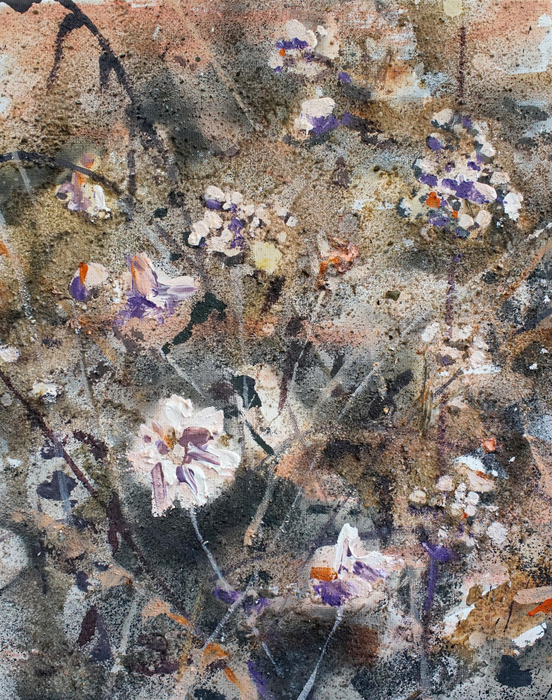
Weeds - 6, 50 x 40 cm, 2026
These works are therefore not only a return to nature, but also an insight into the way we interact with it. They explore the idea that growth always equates to progress. A system that takes without giving anything back. At the same time, nature reveals something else. Even in what we have destroyed or written off, the possibility of new life remains. Not as an excuse to carry on, but as a reminder of what is at stake. The question is not whether everything is interconnected. The question is what we do with that connection — and what happens if we continue to pretend we are separate from it.